


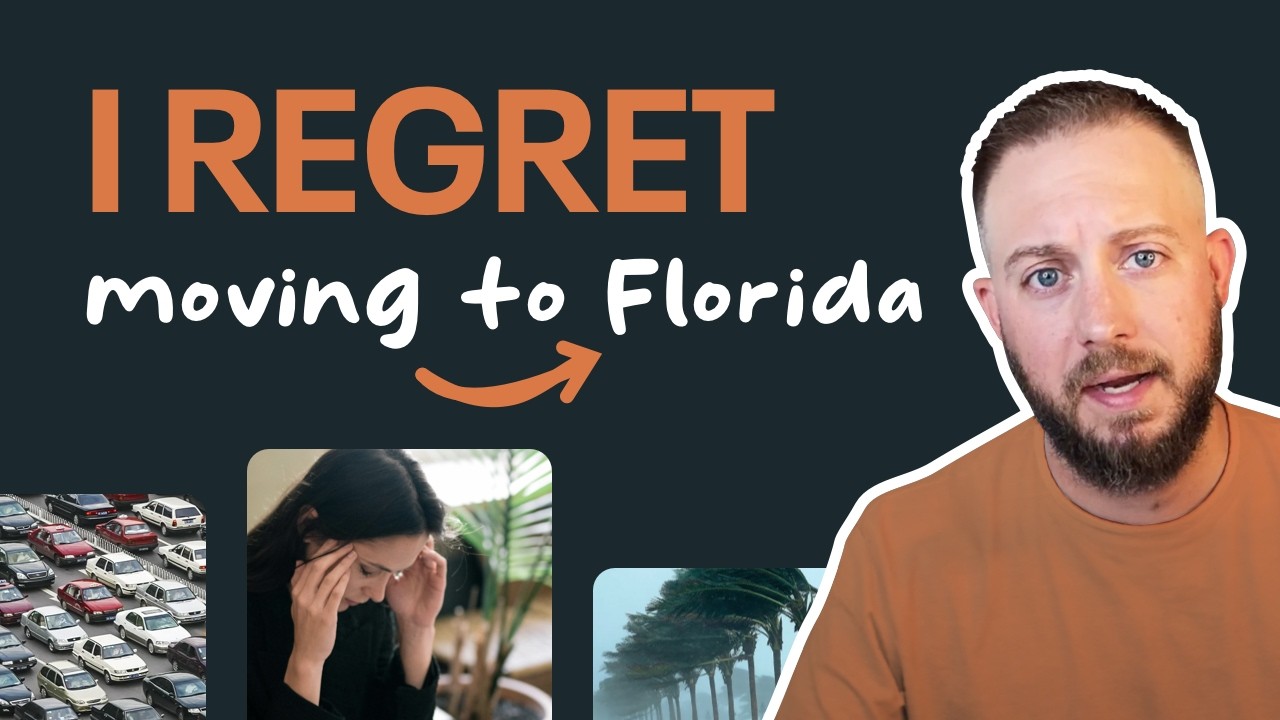
You've heard the pitch: beautiful weather, palm trees, no state income tax, world-class beaches. So why do some people regret moving to Florida?
It sounds strange — but it happens more often than most relocation content will admit. These aren't rare edge cases. They're consistent patterns that show up in real conversations with real people who made the move and found themselves surprised by something they hadn't anticipated.
This guide covers the four biggest regrets people have after moving to Florida, why they happen, and — just as importantly — why for most people who move here with realistic expectations, they don't outweigh the reasons they came.
Frequently Asked Questions: Regrets About Moving to Florida
Do people regret moving to Florida?
Some do — but almost always for predictable, avoidable reasons rather than fundamental problems with Florida itself. The most common regrets involve distance from family and friends, the pace-of-life adjustment, the intensity of Florida summers (and hurricane season), and unexpected housing costs like insurance and HOA fees. People who move here with accurate expectations of these factors are generally very happy. People who move expecting perfection — or without budgeting honestly for the full cost of living — are the ones most likely to struggle.
What do people miss most after moving to Florida?
Family and friends, consistently and almost universally. The first year after a major relocation often involves a honeymoon phase of excitement and exploration, followed by a wave of homesickness when the holidays, birthdays, and ordinary moments of proximity start to register as losses. This doesn't mean the move was wrong — most people work through it by building a local community, scheduling regular trips home, and finding that their old support network actually visits them more once they're in Florida. But underestimating this adjustment is one of the most common sources of early regret.
Is Florida too hot to live in comfortably?
Florida summers are genuinely intense — hotter and more humid than most transplants expect, with daily afternoon thunderstorms from roughly May through September. It's not that the heat is unbearable; it's that it lasts longer than people anticipate. There's no meaningful fall, and summer starts earlier than in most of the country. Locals adapt by shifting outdoor activities to early morning or late afternoon, leaning on beaches and pools to make the heat enjoyable rather than fighting it, and accepting the summer storms as a daily rhythm. For most people, the adjustment takes a season or two — and then the mild winters make it feel entirely worthwhile.
How much does it actually cost to live in Florida?
Florida's lack of state income tax is real and meaningful — but it doesn't make Florida cheap, especially in desirable Gulf Coast areas. Home prices have risen significantly in recent years, and the full carrying costs of a Florida home extend well beyond the mortgage: homeowners insurance (which varies significantly by home age, construction, and flood zone), flood insurance where applicable, HOA fees (ranging from minimal to $400–$800/month in resort communities), CDD fees in master-planned communities, higher summer electric bills from near-constant air conditioning, and pool and lawn maintenance for many properties. Going in without a complete cost picture is one of the most common sources of financial surprise — and one of the most preventable ones with good local guidance.
Is hurricane season in Florida as bad as it looks on the news?
Most years, no. Hurricane season runs from June through November, and the vast majority of hurricane seasons pass without a major storm affecting any given area. Locals prepare, stay informed, and largely treat hurricane preparedness as a normal part of life rather than a constant anxiety. That said, some recent years — including 2024 — have been genuinely difficult with multiple storms, and there are occasional seasons where the anxiety is real and warranted. The honest answer is that hurricane risk is real, insurance costs reflect it, and people who move here should understand what preparation looks like rather than assuming it won't matter.
What is the lifestyle like in Florida compared to the Northeast or Midwest?
Significantly slower and more laid-back — in ways that feel like culture shock at first and feel like relief after adjustment. Businesses close earlier. Things move on a more relaxed timeline. No one is in a rush. For people coming from fast-paced urban environments in the Northeast or Midwest, this can initially feel frustrating — the urgency and efficiency they're used to simply isn't the operating tempo here. Most people, given time, come to love it. The shift from high-stress, high-pace living to a more balanced outdoor-focused lifestyle is often exactly what they came for, once they stop fighting the adjustment.
Why This Conversation Matters
Most Florida relocation content is designed to sell you on the move. The beautiful sunset photos, the beach lifestyle reels, the "no state income tax" headlines. That content isn't wrong — but it's incomplete.
The buyers who are happiest in Florida are consistently the ones who came in knowing both sides: what's genuinely wonderful about living here and what requires real adjustment. The ones who struggle are usually the ones who arrived expecting the highlight reel and encountered reality.
Nick Castenir moved to Florida from Ohio about a decade ago with his wife. They don't regret it — not at all. But they felt some of these things firsthand, and they hear them from clients regularly. What follows is the honest version.
Regret 1: Distance From Family and Friends — This One Hits Harder Than Expected
This is the most universal and consistent regret among people who relocate to Florida, and it almost always surprises them with its intensity.
The first few months after a move are typically a honeymoon phase. You're busy setting up the new home, exploring restaurants and beaches, meeting neighbors, enjoying the weather. Life feels fresh and exciting. The distance from your old support network is easy to tolerate when everything is new.
Then the holidays arrive. Or a family birthday. Or a friend's dinner that you'd normally just drive to. And the distance registers differently than it did when you were in the abstract planning stages of the move.
What makes this harder than people expect: it's not just the big occasions. It's the Sunday dinners. The casual drop-ins. The proximity that allowed spontaneous connection with people you love. That texture of daily life with familiar people around doesn't fully register as something you'll miss until it's gone.
Video calls are genuinely helpful but they don't replace in-person presence, and most people acknowledge that honestly after the first year.
Why this doesn't have to mean regret: this is among the most manageable of the adjustment challenges, with the right approach.
- Schedule trips home with enough regularity that you're not waiting for major occasions to see people
- Make Florida a destination — most people find that family and friends visit significantly more once they're in a place people want to come to, especially in the winter months
- Build your local community deliberately — the people who adapt best are the ones who invest in building relationships here: neighbors, community events, clubs, activities, whatever fits their interests. Once local friendships develop and roots go down, the distance from the old life stops feeling like loss and starts feeling like addition
The regret is real. It's also temporary for most people — not because you stop missing the people you love, but because the new life fills in.
Regret 2: The Pace-of-Life Adjustment — Florida Moves Slower
This one surprises people who think "slower pace" sounds like exactly what they want.
Florida — particularly the Gulf Coast communities outside of Tampa and St. Pete — operates on a fundamentally more relaxed timeline than most Northern and Midwestern cities. Businesses close earlier. Things don't always happen as quickly as you'd like. Service is less urgent. Nobody is in a rush, about anything, ever.
For people who have spent their careers and daily lives in environments where speed and efficiency are the baseline expectation, this can feel actively disorienting at first. Not just relaxing — actually frustrating. The mental adjustment from "things happen fast when I need them to" to "things happen when they happen" takes longer than most people anticipate.
The honest arc: most people who struggle with this initially come to love it within a year or two. The slower pace that felt like friction gradually reveals itself as what they were actually looking for — less stress, more time outside, more presence in daily life, more balance. The urgency that felt normal in their previous lives starts to look like what was actually exhausting them.
But it's worth knowing going in. If you're someone whose identity is closely tied to productivity, speed, and being surrounded by people who operate at your pace — Florida's Gulf Coast lifestyle will require real adjustment. It's not a dealbreaker, but it's a genuine change.
Regret 3: The Weather — Summer Is Longer and Hotter Than You Think
Florida is sunny. Florida is also genuinely hot for a genuinely long time, and the gap between what people expect and what they experience is one of the most consistent sources of first-year surprise.
Summer in Florida isn't just a season — it's a dominant experience that runs from roughly May through October. The heat is real. The humidity is real. The daily afternoon thunderstorms (brief, intense, and predictable) are real. There's no meaningful fall transition; the shift from summer to the cooler months is abrupt and short.
People coming from the Northeast or Midwest often underestimate this because they're calibrating against summers at home, which are shorter and typically less humid. Florida summer is a different category of experience.
How locals adapt:
- Shift outdoor activities to early morning or late afternoon, when the heat is less intense
- Use beaches and pools to make the heat enjoyable rather than avoided — being in the water transforms the experience entirely
- Accept the afternoon storms as a daily rhythm rather than an inconvenience
- Lean into air conditioning unapologetically (and budget for the electric bills)
On hurricane season: it runs June through November, overlapping with summer. Most years are uneventful for any given area. Some years, including recent ones, are genuinely stressful. Locals prepare, monitor weather reports during active periods, and generally treat it as a manageable reality rather than a constant threat. The news coverage of any hurricane is significantly more alarming than the lived experience of most storms for most people — but it's also true that Florida has had some severe seasons recently, and insurance costs reflect that reality.
The perspective that matters: after the first full summer, most people have recalibrated. The mild winters — genuinely, pleasantly mild — start to feel like the reward for the summer. The January mornings when the rest of the country is shoveling snow and you're having coffee on the lanai are the moments people remember.
Regret 4: Housing Costs — Florida Is Not as Cheap as "No Income Tax" Suggests
The no-state-income-tax benefit is real and meaningful, particularly for people with higher incomes or significant retirement distributions. It's one of the legitimate financial advantages of living in Florida.
It does not make Florida cheap.
Home prices in desirable Gulf Coast areas have risen significantly over the past decade, and particularly during the 2020–2023 period. The purchase price is the visible number — but it's the full monthly carrying cost that catches people off guard:
Homeowners insurance — Florida's insurance environment is unlike most of the country. Costs vary dramatically by home age, construction type, roof condition, and proximity to flood zones. For older homes, $4,500–$8,000+ per year is realistic. New construction built to current codes is significantly less — sometimes half — but the insurance calculation is specific to each property.
Flood insurance — separate from homeowners insurance, required for homes in flood zones, and priced based on the property's specific elevation and flood zone designation. Two homes on the same street can have materially different flood insurance costs based on a few feet of elevation difference.
HOA fees — anywhere from minimal (under $100/month in older communities) to $400–$800+/month in resort master-planned communities. The fees fund the amenities; the question is whether you'll use them enough to justify the cost.
CDD fees — assessed annually through the property tax bill in newer master-planned communities. Typically $1,500–$5,000+ per year, depending on the community.
Higher electric bills — air conditioning runs nearly year-round in Florida, and summer months in particular produce bills that surprise people coming from climates where AC is a seasonal expense.
Pool and lawn maintenance — for many Florida homes, both are ongoing costs that don't go away.
Two homes at identical purchase prices can have very different monthly realities depending on their age, location, community structure, and flood zone. This is exactly why having a local agent who understands the full cost picture — not just the purchase price — matters in a way that it doesn't in simpler markets.
The Honest Counterpoint: Why Most People Don't Regret It
All four of these are real. None of them are dealbreakers for the right person with the right expectations.
Nick and his wife moved from Ohio a decade ago. They knew none of these things in advance the way clients do now. They felt the distance from family, the pace adjustment, the summer shock. They still don't regret it — not even slightly.
What makes the difference, consistently, is expectations.
People who move to Florida knowing what they're choosing — the tradeoffs alongside the benefits — are almost universally happy. People who move expecting the highlight reel and no friction are the ones who struggle.
The specific things that tend to tip the balance toward no-regret:
- Building a community here. People who invest in local friendships — through neighbors, activities, community events, whatever fits their interests — report significantly higher satisfaction. Florida rewards active social investment.
- Using the lifestyle. The beach, the outdoor activities, the mild winters — people who genuinely use these things daily are happier than those who move here and recreate the indoor lifestyle they had elsewhere.
- Having family visit. Florida is a destination. Most people find their family and old friends visit them more after the move than before, which addresses the distance regret more effectively than most people anticipate.
- Understanding the costs before moving. The financial surprises are entirely preventable with good local guidance. Going in with a complete cost picture — insurance, HOA, CDD, utilities, maintenance — eliminates the most common source of financial regret.
Is Florida Right for You?
The honest answer to this question isn't yes or no — it's a function of fit.
Florida is genuinely excellent for people who:
- Value outdoor lifestyle, beach access, and year-round warmth as daily experiences
- Are willing to invest in building a new social community
- Have the flexibility to travel home regularly in the early years
- Can budget accurately for the full cost of Florida homeownership
- Want a slower pace and are willing to adjust to it
Florida requires real consideration for people who:
- Have deep family obligations that require frequent, spontaneous proximity
- Are not prepared to budget for insurance, HOA, and other carrying costs beyond the purchase price
- Struggle with heat and won't adapt outdoor schedules accordingly
- Want an urban, fast-paced lifestyle (which is available in Tampa and St. Pete, but not throughout the Gulf Coast)
The gap between regret and no-regret is almost never about Florida itself — it's about whether the move was made with honest, complete information or with an incomplete picture of what daily life here actually looks like.
Conclusion: The Move Works When the Expectations Are Accurate
Florida is not perfect. The summers are long and hot. Hurricane season is real. Family feels far. The pace is slower than you're used to. The full cost of living is higher than "no state income tax" implies.
And: the lifestyle, the beaches, the weather from October through April, the outdoor activity, the community, the warmth — for the right person, these things make all of those adjustments feel entirely worth it.
The goal isn't to scare you off Florida. It's to help you move here the right way — knowing what you're choosing, planning for the adjustments, and arriving with expectations that reality can actually meet.
That's the difference between the people who call it the best decision they ever made and the ones who end up selling after two years.
Thinking About Moving to Florida's Gulf Coast?
Nick Castenir and the Zachos Realty & Design Group team help families, retirees, and relocation buyers from across the country figure out whether Florida's Gulf Coast is actually the right move for them — honestly, not just enthusiastically.
Contact us today:
- Phone: 941-500-5457
- Email: [email protected]
- Sarasota Office: 205 N Orange Ave Suite 202, Sarasota, Florida 34236
- Venice Office: 217 Nassau St S, Venice, FL 34285
Visit our YouTube channel "Relocation Experts | Florida's Gulf Coast" for more insider guides to Florida's Gulf Coast communities.
Check out this article next