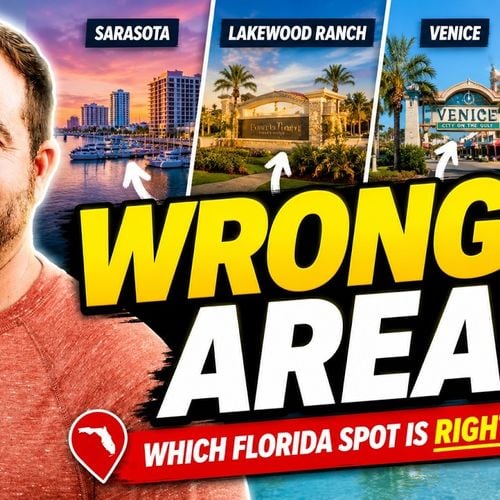



Florida's Gulf Coast is still growing — Sarasota, Venice, Lakewood Ranch, and surrounding communities continue to attract buyers even as dramatic headlines claim the state is emptying out. The real story is more nuanced: some people are leaving bad fits and bad financial decisions, while others are still arriving because the lifestyle and the numbers still work for them.
Introduction
If you've spent any time online recently searching for information about moving to Florida, you've probably run into a wave of alarming headlines. "People Are Fleeing Florida." "The Florida Exodus." "Is Florida's Boom Over?" It can be enough to make anyone pause and second-guess a relocation plan that felt solid just a few months ago.
Here's what you need to know about that narrative: it's incomplete at best, and misleading at worst. The Gulf Coast real estate market — from Sarasota and Venice to Lakewood Ranch and Wellen Park — tells a far more layered story than any single headline can capture. In this guide, you'll discover what the actual data shows about Florida's population trends, why some people are leaving, why many more are still arriving, and most importantly, how to figure out which category you'll fall into.
Frequently Asked Questions About Moving to Florida's Gulf Coast in 2026
Is Florida's population actually declining?
No. As of the most recent official data, Florida is still adding population. Domestic migration slowed considerably from the pandemic-era peak, but it remained positive — meaning more people moved into Florida than out of it. Florida continues to be one of the country's strongest magnets for international migration as well.
Why are some people leaving Florida?
Some residents and recent transplants are leaving because Florida got significantly more expensive over the past several years. Rising housing costs, challenging insurance markets, property taxes, and HOA fees have created a monthly payment burden that no longer feels worth it for some homeowners. People who bought properties with thin financial margins — especially in higher-risk flood zones or in older homes with deferred maintenance — are most likely to feel squeezed.
Is the Gulf Coast real estate market still active?
Yes. Communities like Sarasota, Venice, Lakewood Ranch, and Wellen Park continue to see demand, development, and buyer traffic. Sarasota and Manatee counties are still experiencing year-over-year population growth and appreciation. Builders are still constructing new homes because market demand supports it.
What types of buyers are still moving to Florida?
The buyer profile has shifted from impulsive to intentional. Today's Gulf Coast buyer asks detailed questions about flood zones, roof ages, insurance costs, HOA fees, and true monthly payment totals before making a commitment. These more selective, better-informed buyers tend to be much happier with their decision in the long run.
Is now a bad time to buy on Florida's Gulf Coast?
Not necessarily — it depends entirely on your individual circumstances. The question isn't whether Florida is "good" or "bad" in general; it's whether your specific budget, lifestyle goals, and risk tolerance align with the type of Florida you want. Running a complete monthly cost analysis before falling in love with any property is essential.
What makes a Florida move succeed versus fail?
Successful moves tend to involve buyers who chose the right property type (newer construction vs. older resale), the right location (flood zone considerations, proximity to water), and the right community (HOA fees and amenities that match their lifestyle and budget). Failed moves often involve buyers who stretched financially, ignored risk factors, or moved primarily expecting Florida to be dramatically cheaper than their origin state.
What are the best communities on Florida's Gulf Coast for relocators?
Sarasota, Venice, Lakewood Ranch, Nokomis, and Wellen Park are among the most popular Gulf Coast destinations for relocators in 2026. Each offers a distinct lifestyle profile: Sarasota for culture and coastal access, Venice for a charming small-town feel, Lakewood Ranch for master-planned amenities and family living, and Wellen Park for new construction in a vibrant, newer development.
Why the "Everyone Is Leaving Florida" Headline Exists
To be fair, the headlines didn't come out of nowhere.
Florida got more expensive — that part is absolutely true. Housing costs climbed sharply during the pandemic migration wave, and they haven't fully retreated. Insurance remains one of the most cited frustrations among Florida homeowners, particularly in coastal areas or neighborhoods with older housing stock. Property taxes, once you've owned for a year or two, can surprise buyers who didn't fully account for them in their original budgets. And HOA fees in amenity-rich communities add up quickly.
For some people who moved here during the peak of the pandemic boom — often moving fast, buying emotionally, and not fully running the numbers — Florida turned out to be a financial stress test rather than the dream lifestyle they expected. Those stories are real. And for long-time locals who built their lives here before prices surged, there's a genuine affordability squeeze happening too.
If you read only those stories or only the most dramatic headlines, it's easy to conclude that everyone is leaving. But that conclusion requires ignoring a significant portion of the picture.
What the Data Actually Shows
The actual data on Florida migration and population tells a different story.
Florida is still growing. Domestic migration slowed dramatically from its pandemic-era highs — that's true and significant. But slower than before is not the same thing as collapsing or reversing. Florida remained net positive on domestic migration, and international migration continued at a healthy pace as well.
Key takeaway: A cooldown from a historically extraordinary peak is not an exodus. It's normalization.
Here on Florida's Gulf Coast specifically, the on-the-ground evidence makes the "everyone is leaving" narrative hard to sustain. Sarasota and Manatee counties are still growing year-over-year in both population and property values. Builders are still constructing new homes and new communities — and builders don't build where demand has disappeared. Traffic is heavier. Restaurants are busier. Golf communities are active. New retail and commercial development is ongoing.
These are not the characteristics of a market in collapse. They are the characteristics of a market that cooled from an extraordinary high and is now finding a more sustainable pace.
The Real Story: Florida Got More Complicated, Not More Empty
Here's the more accurate way to think about what's happening: Florida didn't empty out. Florida just got less forgiving of bad decisions.
During the pandemic buying frenzy, buyers moved fast, asked fewer questions, and often stretched financially to get into the market. Some of those buyers are now experiencing the consequences of decisions made in a frenzied environment. They're dealing with insurance costs they didn't fully anticipate, maintenance needs on older homes, or a monthly payment that made sense when interest rates were lower but no longer feels comfortable.
Those buyers are leaving — and honestly, that's understandable. But they're not leaving because Florida is over. They're leaving because their specific situation stopped making sense.
At the same time, a different type of buyer is still arriving: someone who has done their homework, run the full monthly numbers, understands the trade-offs between coastal and inland properties, and is moving here for clear, concrete lifestyle reasons. That buyer tends to find Florida exactly what they expected — because they expected the right things.
Who Is Still Coming to Florida's Gulf Coast?
The demand hasn't disappeared. It has shifted.
The Lifestyle-Driven Buyer
Many of the buyers still arriving on the Gulf Coast are motivated by concrete lifestyle benefits that Florida genuinely delivers: year-round warm weather, outdoor living, access to the Gulf of Mexico, golf, boating, walking and biking trails, and a day-to-day pace that's simply different from the Northeast or Midwest. For buyers whose math works and whose lifestyle goals align with what Florida offers, the case for moving here remains strong.
The Strategic Relocator
Some buyers who might have once focused exclusively on beach-close properties are now making more strategic decisions. They might be choosing newer construction in communities like Lakewood Ranch or Wellen Park — where insurance numbers are more manageable and carrying costs are more predictable — over older coastal homes with higher risk profiles. This isn't retreating from Florida. This is smart, selective buying.
The "Repositioner"
Interestingly, some of the people counted in outflow statistics aren't really leaving Florida in any meaningful sense. They're repositioning within the state — moving from a higher-cost coastal area to a slightly inland community, or downsizing from a larger property to a more manageable one. They're simplifying, not surrendering.
Important distinction: Repositioning within Florida looks like "leaving" in certain migration data cuts, but it's actually a sign of a maturing market where buyers are making more deliberate, lifestyle-informed choices.
The Four Questions Every Potential Gulf Coast Buyer Should Ask
If you're considering a move to Florida's Gulf Coast and you're trying to cut through the noise, these are the questions that actually matter.
1. What Does Your Full Monthly Payment Look Like?
This is the single most important calculation you can make. Your full monthly payment includes:
- Mortgage principal and interest
- Property taxes (which adjust after purchase based on assessed value)
- Homeowner's insurance (get actual quotes, not estimates)
- HOA fees (and understand exactly what they cover)
- Flood insurance if applicable
- Anticipated maintenance and utility costs
Many buyers who end up struggling in Florida made one critical mistake: they fell in love with a house before they calculated the total monthly cost of owning it. Do this math before you fall in love with anything.
2. Are You Buying in the Right Location for Your Risk Tolerance?
Not all Florida properties carry the same risk profile. Beach-close properties in flood zones offer extraordinary lifestyle value but also carry higher insurance costs, more maintenance considerations from salt air and humidity, and greater weather event exposure. Inland communities with newer construction often carry lower insurance premiums and more predictable cost structures.
Neither is objectively better — but they are genuinely different, and the right choice depends on your priorities and your budget.
3. Are You Moving for the Right Reasons?
If your primary motivation is that you expect Florida to be dramatically cheaper than wherever you're coming from, you may be disappointed. Florida is not inexpensive. The cost of living here — particularly once you factor in the full ownership cost of a home — is meaningful.
However, if you're moving for weather, outdoor lifestyle, water access, golf, a slower pace of daily life, and a community that aligns with your interests, those benefits are real and lasting. Buyers who move for concrete lifestyle reasons tend to be satisfied. Buyers who move primarily for financial arbitrage tend to be surprised.
4. Have You Looked at Newer Construction vs. Older Resale?
This distinction matters enormously on Florida's Gulf Coast. Newer homes — particularly those built in the last five to ten years — generally feature stronger building codes, hurricane-rated windows and doors, newer roofs, and better insurance eligibility. Older resale homes can offer incredible value and character, but they require a much more rigorous inspection process and a clearer understanding of what deferred maintenance might be lurking.
What the Shift in Buyer Behavior Actually Tells Us
One of the most encouraging signs for the health of the Gulf Coast market is the quality of questions today's buyers are asking.
A few years ago, buyers in this market were primarily driven by urgency and emotion. They wanted to get in before prices climbed further, and many bought without asking the hard questions. Today's buyer is different. They want to know:
- What flood zone is this property in?
- How old is the roof, and when will it need replacing?
- Are the windows and doors hurricane-rated?
- What does insurance actually cost — not an estimate, the real number?
- What are the full HOA fees, and what's included?
- What is the real total monthly payment?
This is a healthier market. Buyers making more informed decisions are more likely to be satisfied with those decisions. They're less likely to become the cautionary tales that generate dramatic headlines two years later.
Sarasota, Venice, Lakewood Ranch, and Wellen Park: What the Market Looks Like on the Ground
For buyers considering a relocation to Florida's Gulf Coast specifically, here's a ground-level snapshot of what the market actually looks like in the communities most popular with relocators.
Sarasota
Sarasota remains one of the most desirable mid-sized cities on Florida's Gulf Coast. Its combination of cultural amenities — world-class arts institutions, diverse dining, and proximity to some of the state's most celebrated beaches — continues to attract buyers from across the country. The market here is active, with continued appreciation in well-located neighborhoods.
Venice
Venice offers a charming small-town feel with a walkable downtown, beautiful beaches, and a strong sense of community. It draws buyers who want the Florida lifestyle without the intensity of a larger city. Demand here remains consistent, supported by both retirees and working-age buyers who appreciate the area's quality of life.
Lakewood Ranch
Lakewood Ranch continues to be one of the best-selling master-planned communities in the United States. Its range of neighborhoods — from more affordable villa and townhome options to luxury estate homes — makes it accessible across a wide range of budgets. New construction is ongoing, amenities are extensive, and the community infrastructure is well-established.
Wellen Park
Wellen Park represents one of the Gulf Coast's most exciting newer developments. This master-planned community has grown rapidly and continues to attract buyers seeking new construction in a community with a thoughtfully designed downtown, retail, dining, and recreational amenities. Its newer homes tend to have very favorable insurance profiles, which is a meaningful practical advantage.
The Bottom Line: Is Everyone Really Leaving Florida?
No. Not in the way the headlines suggest.
The more accurate picture is this: Florida got more expensive and more complicated over the past five years, and some buyers who made decisions without fully understanding those complexities are now dealing with the consequences. That's real, and it generates headlines.
But Florida's Gulf Coast — Sarasota, Venice, Lakewood Ranch, Wellen Park, and the surrounding communities — is still growing, still developing, and still attracting buyers who are moving for the right reasons with the right information.
The market has matured. It's more selective now, which is healthier for everyone. Buyers who do their homework, run the full numbers, understand what they're buying and why, and move for concrete lifestyle reasons are still finding the Gulf Coast to be an excellent choice.
Florida isn't easy anymore. But for the right buyer, it's still very much worth it.
Ready to Explore Florida's Gulf Coast?
If you're considering relocating to Sarasota, Venice, Lakewood Ranch, Wellen Park, or anywhere else on Florida's beautiful Gulf Coast, the Zachos Realty & Design Group is here to help. With over 40 years of local expertise and a unique combination of real estate knowledge and award-winning design vision, we can help you find the perfect property that matches your lifestyle needs.
Contact us today:
- Phone: 941-500-5457
- Email: [email protected]
- Sarasota Office: 205 N Orange Ave Suite 202, Sarasota, Florida 34236
- Venice Office: 217 Nassau St S, Venice, FL 34285
Visit our YouTube channel "Relocation Experts | Florida's Gulf Coast" for more insider guides to Florida's Gulf Coast communities.
Check out this article next